What Is Unani Medicine? Principles, Education & Career Opportunities
Are you interested in traditional systems of medicine and holistic approaches to health and wellness? Unani medicine is one of the traditional systems of medicine practised in India, with a long history of knowledge relating to health, diet, lifestyle, medicinal substances, and therapeutic practices.
Students who want to learn about Unani medicine can explore educational programmes according to their qualifications and career interests. These may include introductory certificate courses and diploma programmes, depending on the institution offering them.
In this blog, we will explain what Unani medicine is, its fundamental principles, educational pathways, eligibility criteria, course duration, and potential career opportunities. We will also cover three courses: Diploma in Unani Science, Diploma in Hijama Therapy, and Certificate of Basic Unani.
What Is Unani Medicine?
Unani medicine, also known as Unani Tibb, is a traditional system of medicine with historical roots in Greek medicine that developed further through Arabic and Persian medical scholarship.
The system focuses on understanding the human body's temperament, maintaining health, dietary practices, lifestyle, and traditional therapeutic approaches. In India, Unani is recognised as one of the traditional systems of medicine and is associated with the broader AYUSH framework.
Unani medicine includes concepts relating to the balance of bodily humours, individual temperament, environmental influences, and the role of diet and lifestyle in maintaining health.
It is important to distinguish learning about Unani traditions from being professionally qualified to diagnose diseases or practise as a registered Unani medical practitioner. Such professional practice is subject to applicable qualification, recognition, and registration requirements.
Principles of Unani Medicine
Unani medicine is based on a traditional theoretical framework that includes several important concepts. Understanding these concepts helps students appreciate the system's approach to health and wellness.
1. Mizaj (Temperament)
Mizaj refers to temperament. In Unani theory, individuals, foods, medicinal substances, and environmental influences are described in terms of qualities such as hot, cold, moist, and dry.
Traditional Unani approaches use the concept of temperament to understand individual differences and guide dietary and therapeutic decisions.
2. Akhlat (Humours)
The classical Unani framework describes four humours:
- Dam: Blood.
- Balgham: Phlegm.
- Safra: Yellow bile.
- Sauda: Black bile.
Traditional Unani theory associates these humours with the body's functioning and health. These are historical concepts within the system and should not be interpreted as equivalent to modern biomedical explanations of physiology.
3. Arkan (Elements)
Arkan refers to the four classical elements: earth, water, air, and fire. In traditional Unani philosophy, these elements form part of the theoretical explanation of the natural world and the human body.
4. Aaza (Organs)
Aaza refers to the organs or bodily structures discussed within Unani medical theory. The study of bodily structures and their functions is relevant to understanding the traditional system's approach to health.
5. Af'al (Functions)
Af'al refers to functions or activities of the body. The concept concerns how bodily processes are understood within the Unani framework.
6. Hifz-e-Sehat (Preservation of Health)
Hifz-e-Sehat refers to the preservation or maintenance of health. Traditional Unani teachings place emphasis on factors such as diet, physical activity, rest, environmental conditions, and daily routines.
These principles form part of the traditional Unani knowledge system. Specific medical treatments should be evaluated for safety and effectiveness, and individuals should seek appropriate qualified healthcare advice for medical conditions.
Education in Unani Medicine
Students interested in Unani medicine can explore educational options based on their previous qualifications and professional goals.
The appropriate pathway depends on whether a student wants an introduction to Unani concepts, specialised training in a particular therapy, or a recognised professional qualification in Unani medicine.
The three courses covered below have the eligibility and duration details provided for this blog. Their precise curriculum, awarding body, and professional status should be verified with the institution before admission.
Unani Courses: Eligibility and Duration
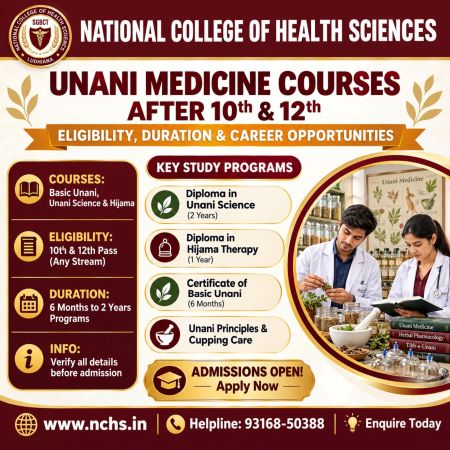
Here is an overview of the three programmes.
|
Course Name |
Eligibility |
Duration |
|
Certificate of Basic Unani |
10th Pass |
6 Months |
|
Diploma in Unani Science |
12th Pass, Any Stream |
2 Years |
|
Diploma in Hijama Therapy |
12th Pass, Any Stream |
1 Year |
Note: The eligibility criteria and durations above are based on the course information supplied for this article. They should not be interpreted as confirmation that the programmes are recognised medical qualifications or confer professional registration rights.
1. Certificate of Basic Unani
The Certificate of Basic Unani is a six-month programme intended for students who want to develop introductory knowledge of Unani concepts and traditional health practices.
It may be suitable for learners who want to understand the terminology, foundational principles, and historical background of the Unani system.
Eligibility Criteria
Students who have passed Class 10 may consider this course, subject to the admission requirements of the institution.
Course Duration
The duration of the Certificate of Basic Unani is 6 months.
What Will You Learn?
Depending on the prescribed syllabus, the programme may introduce students to:
- An introduction to Unani medicine and its history.
- Basic principles of Unani theory.
- The concepts of Mizaj and Akhlat.
- Traditional approaches to diet and lifestyle.
- Introduction to commonly discussed Unani medicinal substances.
- General health and wellness concepts within the tradition.
Who Should Consider This Course?
This course may be relevant to students who want an introductory understanding of Unani medicine before exploring further education.
Students should check whether the course is designed for general educational purposes, occupational training, or a specific professional pathway. A basic certificate should not be assumed to qualify its holder to practise medicine.
2. Diploma in Unani Science
The Diploma in Unani Science is a two-year programme listed for students who have completed Class 12 in any stream.
The programme may be of interest to learners seeking a structured introduction to Unani concepts, traditional health knowledge, and related educational subjects.
Eligibility Criteria
The stated eligibility is Class 12 pass in any stream, subject to the admission policy of the institution offering the programme.
Course Duration
The duration of the Diploma in Unani Science is 2 years.
What Will You Learn?
The actual curriculum must be confirmed with the institution. Depending on the programme, educational topics may include:
- History and foundational concepts of Unani medicine.
- Traditional theories of temperament and humours.
- Introduction to Unani terminology.
- Traditional dietary and lifestyle principles.
- Overview of Unani medicinal substances.
- Introduction to traditional therapeutic approaches.
- Basic concepts of health education and wellness.
The list above describes possible areas of study and is not a verified syllabus for every Diploma in Unani Science programme.
Career Opportunities After Diploma in Unani Science
Depending on the course's actual scope, the awarding institution, and the requirements of the role, learners may explore suitable opportunities related to:
- Educational support in traditional medicine settings.
- Administrative or coordination roles in relevant organisations.
- General health education and wellness activities within their competence.
- Further study in traditional medicine or related fields, where eligible.
Important: The title “Diploma in Unani Science” does not by itself establish eligibility to diagnose, prescribe medicines, treat patients independently, or use a protected professional designation. Students must verify the qualification's recognition and legal status before enrolling, particularly if their goal is to become a practising Unani physician.
3. Diploma in Hijama Therapy
The Diploma in Hijama Therapy is a one-year programme listed for students who have completed Class 12 in any stream.
Hijama is a traditional cupping practice associated with Unani and other traditional health systems. Depending on the method, cupping may involve applying cups to the skin to create suction. Wet cupping involves additional procedures that may include superficial skin incisions and therefore requires particular attention to hygiene, infection prevention, and safety.
A course in this area may introduce learners to the history, traditional context, methods, and safety considerations associated with cupping.
Eligibility Criteria
The stated eligibility is Class 12 pass in any stream, subject to the institution's admission requirements.
Course Duration
The duration of the Diploma in Hijama Therapy is 1 year.
What Will You Learn?
Depending on the syllabus, the programme may cover:
- Introduction to Hijama and its traditional background.
- Basic concepts associated with cupping practices.
- Different types of cupping and their traditional uses.
- Hygiene and infection-prevention principles.
- Equipment handling and sanitation.
- Contraindications, precautions, and safety considerations.
- Client communication and referral procedures.
The exact content and practical requirements should be obtained from the institution before admission.
Career Opportunities After Diploma in Hijama Therapy
Possible pathways depend on the nature of the qualification, the student's practical training, and applicable laws and professional requirements.
Learners may explore relevant educational support or assistant roles in settings where their qualifications are accepted. Any hands-on therapy must be undertaken only when the individual is legally permitted, adequately trained, and working within the scope of their competence.
Students should not assume that a one-year diploma independently authorises them to diagnose medical conditions, prescribe treatment, perform invasive procedures, or operate a clinical practice.
What Is the Difference Between Unani Medicine and Hijama Therapy?
Although Hijama is associated with traditional Unani practice, it is not the same as the entire Unani medical system.
|
Basis |
Unani Medicine |
Hijama Therapy |
|
Meaning |
A broader traditional system of medicine |
A particular cupping practice |
|
Scope |
Includes traditional theories, diet, lifestyle, medicinal substances, and therapeutic approaches |
Focuses on cupping methods and associated precautions |
|
Education |
May involve introductory programmes or recognised professional medical education |
May involve specialised therapy-related training |
|
Career pathway |
Depends on the qualification and applicable professional requirements |
Depends on the training, legal scope, and requirements of the specific role |
A course in Hijama Therapy should not automatically be treated as equivalent to a recognised qualification in Unani medicine.
Career Opportunities in the Field of Unani Medicine
Career options depend substantially on the qualification earned. A short certificate or diploma may provide educational exposure, but it does not necessarily confer the professional rights associated with a recognised medical degree.
1. Traditional Medicine Education
Learners may pursue further education or suitable educational support roles related to traditional medicine, depending on their qualifications and the institution's requirements.
2. Health and Wellness Education
Individuals with appropriate training may contribute to general health education and wellness activities that remain within their knowledge and permitted scope of work.
3. Administrative and Coordination Roles
Some learners may explore administrative, programme coordination, or support roles in organisations involved in traditional medicine or wellness education.
4. Therapy-Related Support Roles
Graduates of specialised therapy programmes may investigate assistant or support roles where the employer accepts their qualification and the activities fall within applicable legal and safety requirements.
5. Further Professional Education
Students who want to become qualified Unani medical practitioners should investigate the recognised professional education pathway rather than assuming that an introductory certificate or private diploma is sufficient.
In India, the Bachelor of Unani Medicine and Surgery (BUMS) is a recognised professional education pathway subject to the applicable admission, institution recognition, course completion, internship, and registration requirements. The National Commission for Indian System of Medicine (NCISM) publishes relevant regulations and information on recognised Unani medical qualifications.
How to Choose the Right Unani Course
Before selecting a programme, consider the following factors.
1. Your Educational Qualification
Choose a course for which you meet the stated eligibility criteria. The programmes discussed in this blog list Class 10 as the entry requirement for the Certificate of Basic Unani and Class 12 for both diploma programmes.
2. Your Learning Objective
Decide whether you want introductory knowledge, specialised learning about cupping, or a professional medical qualification. These goals may require different educational pathways.
3. Course Curriculum
Request the detailed syllabus, practical training schedule, assessment method, and information about the certificate or diploma that will be awarded.
4. Recognition and Affiliation
Check the institution's legal status, the awarding body, and any applicable recognition or affiliation. Do not rely solely on a course title, promotional claim, or certificate design.
5. Career Eligibility
If your objective is employment or professional practice, verify the actual eligibility criteria for the role you want to pursue before paying admission fees.
Admission Process for Unani Courses
The admission process varies by institution. Students can generally follow these steps:
- Select the course: Choose a programme that matches your educational qualification and learning goals.
- Review eligibility: Check the official eligibility criteria and course duration.
- Obtain the syllabus: Request details of practical training, if applicable.
- Verify recognition: Check the institution, awarding body, affiliation, and professional recognition status.
- Confirm fees and assessment: Ask for complete information about tuition fees, examination fees, assessments, and the final qualification.
- Submit the application: Provide the required documents after reviewing the terms of admission.
Students should request written clarification if an institution makes claims about government recognition, professional registration, clinical practice, or eligibility for employment.
Important Information About Recognition and Professional Practice
This distinction is particularly important for students considering courses in Unani medicine.
The three programmes discussed in this article—Certificate of Basic Unani, Diploma in Unani Science, and Diploma in Hijama Therapy—are included according to the course details supplied for this blog. Their names and stated durations alone do not confirm recognition as medical qualifications.
Before enrolling, students should:
- Verify whether the qualification appears in the relevant official recognition records, where applicable.
- Confirm whether the awarding body is authorised to issue the qualification.
- Check whether the course meets the requirements for any intended job or professional registration.
- Understand that training in traditional concepts or a specialised therapy does not automatically authorise independent medical practice.
For professional Unani medical education in India, refer to the National Commission for Indian System of Medicine (NCISM) and the applicable state registration authority. Official information is available through the NCISM website: https://www.ncismindia.org/
Frequently Asked Questions (FAQs)
1. What is Unani medicine?
Unani medicine is a traditional system of medicine with historical roots in Greek medicine and further development through Arabic and Persian scholarship. It includes traditional concepts relating to temperament, humours, diet, lifestyle, and therapeutic practices.
2. Can I study Unani-related courses after Class 10?
According to the course details provided for this blog, students who have passed Class 10 may consider the Certificate of Basic Unani, which has a stated duration of six months.
3. Which Unani-related courses are available after Class 12?
The courses covered here are the Diploma in Unani Science, with a stated duration of two years, and the Diploma in Hijama Therapy, with a stated duration of one year. Both list Class 12 in any stream as the eligibility requirement, subject to the institution's admission policy.
4. What is the duration of the Diploma in Unani Science?
The stated duration of the Diploma in Unani Science is two years.
5. What is the duration of the Diploma in Hijama Therapy?
The stated duration of the Diploma in Hijama Therapy is one year.
6. Is Hijama the same as Unani medicine?
No. Hijama is a specific cupping practice associated with Unani and other traditional systems. Unani medicine is a broader system that encompasses traditional theories, diet, lifestyle, medicinal substances, and therapeutic approaches.
7. Can I become a Unani doctor after completing a diploma?
You should not assume that a diploma automatically qualifies you to practise as a Unani doctor. Professional practice requires the appropriate recognised qualification and registration under applicable rules. Verify the status of the specific course with the relevant official authority.
8. Does a certificate or diploma guarantee a job?
No. Employment depends on the qualification's acceptance, the employer's requirements, the individual's skills, and other applicable criteria.
Conclusion
Unani medicine is a traditional system of medicine with a distinct theoretical framework and a long history of educational and therapeutic practices. Students interested in this field can explore introductory and specialised programmes according to their qualifications and learning objectives.
The three programmes covered in this blog are:
- Certificate of Basic Unani: 10th pass, 6 months.
- Diploma in Unani Science: 12th pass, any stream, 2 years.
- Diploma in Hijama Therapy: 12th pass, any stream, 1 year.
These details reflect the course information supplied for this article and should be verified with the relevant institution. Before taking admission, carefully check the syllabus, awarding body, recognition status, practical training, and career eligibility associated with the qualification.
Making an informed decision can help you choose an educational programme that aligns with your interests while keeping your future career plans and professional responsibilities clear.