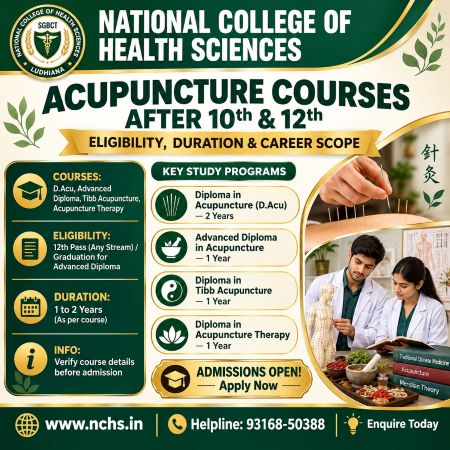
Acupuncture Courses in India: Eligibility, Duration & Career Scope
Are you interested in acupuncture, traditional therapeutic practices, and healthcare-related education? Acupuncture is a therapeutic technique that involves stimulating specific points on the body, commonly using fine needles. It has a long history in traditional Chinese medicine and is used in some healthcare settings as a complementary approach.
Students interested in learning about acupuncture can explore educational programmes that introduce its principles, techniques, safety considerations, and practical applications. Before choosing a course, it is important to understand the eligibility criteria, duration, training requirements, and professional limitations associated with the qualification.
In this blog, we will explain acupuncture courses in India, eligibility requirements, course duration, educational pathways, and potential career scope. We will also cover four courses: Diploma in Acupuncture (D.Acu), Advanced Diploma in Acupuncture, Diploma in Tibb Acupuncture, and Diploma in Acupuncture Therapy.
What Is Acupuncture?
Acupuncture is a therapeutic technique traditionally associated with Chinese medicine. It generally involves inserting very fine needles into specific points on the body by a trained practitioner.
The technique is used in some healthcare settings as a complementary intervention, including for certain types of pain. However, its effectiveness varies by condition, and it should not be presented as a guaranteed treatment or a substitute for necessary medical care.
Acupuncture education may include theoretical knowledge, identification of acupuncture points, treatment principles, practical techniques, hygiene, and patient safety.
Because acupuncture involves needles and may carry risks such as infection, bleeding, or injury, appropriate training, safe procedures, and knowledge of contraindications are essential.
Acupuncture Courses in India: Overview
Students can compare different acupuncture-related courses according to their educational qualifications and career objectives.
|
Course Name |
Eligibility |
Duration |
|
Diploma in Acupuncture (D.Acu) |
12th Pass, Any Stream |
2 Years |
|
Advanced Diploma in Acupuncture |
Graduation in a Relevant Field |
1 Year |
|
Diploma in Tibb Acupuncture |
12th Pass, Any Stream |
1 Year |
|
Diploma in Acupuncture Therapy |
12th Pass, Any Stream |
1 Year |
Important: The eligibility criteria and durations in this table are based on the course details provided for this article. Students should confirm the current admission requirements, syllabus, practical training, awarding body, and applicable professional requirements directly with the institution.
1. Diploma in Acupuncture (D.Acu)
The Diploma in Acupuncture (D.Acu) is a two-year programme listed for students who have completed Class 12 in any stream.
It may be of interest to learners who want to study the foundations of acupuncture, understand its traditional principles, and develop knowledge of the techniques used in acupuncture practice.
Eligibility Criteria
Students who have passed Class 12 in any stream may consider this programme, subject to the admission requirements of the institution offering it.
Course Duration
The duration of the Diploma in Acupuncture (D.Acu) is 2 years.
What Will You Learn?
Depending on the prescribed syllabus, the programme may include:
- Introduction to acupuncture and its historical background.
- Basic concepts and principles of acupuncture.
- Introduction to acupuncture points and meridians.
- Fundamental techniques and terminology.
- Anatomy and physiology relevant to safe practice.
- Hygiene, infection prevention, and equipment handling.
- Contraindications, precautions, and referral principles.
The actual curriculum and practical training arrangements should be verified before admission.
Career Scope After D.Acu
Depending on the qualification's status, the learner's training, and applicable requirements, possible pathways may include further study or suitable support roles in organisations that provide acupuncture-related education or services.
Students seeking to perform acupuncture procedures should first establish whether their qualification permits the intended activities in the relevant jurisdiction. A diploma title alone does not establish legal eligibility for independent clinical practice.
2. Advanced Diploma in Acupuncture
The Advanced Diploma in Acupuncture is a one-year programme listed for applicants who have completed graduation in a relevant field.
It may be suitable for eligible graduates who want to pursue further structured learning in acupuncture-related techniques and concepts.
Eligibility Criteria
The stated eligibility is graduation in a relevant field. The institution should clarify which degree subjects and qualifications are accepted.
Course Duration
The duration of the Advanced Diploma in Acupuncture is 1 year.
What Will You Learn?
Depending on the programme, learning areas may include:
- Advanced theoretical concepts in acupuncture.
- Acupuncture point identification and related terminology.
- Applied anatomy and physiology.
- Clinical safety and infection prevention.
- Practical demonstrations and supervised training, where included.
- Contraindications and situations requiring medical referral.
- Ethical responsibilities and professional boundaries.
These topics are indicative only; the institution's official syllabus should be consulted for exact details.
Career Scope After the Advanced Diploma
Graduates may investigate further educational opportunities or roles relevant to their existing professional background and additional training.
However, completing an advanced diploma does not automatically confer a recognised medical qualification or expand an individual's existing professional scope of practice. Applicants should confirm the course's recognition and intended employment eligibility before enrolling.
3. Diploma in Tibb Acupuncture
The Diploma in Tibb Acupuncture is a one-year programme listed for students who have passed Class 12 in any stream.
The term Tibb is associated with medicine or healing in several traditional medical contexts. Students considering this course should review its specific curriculum to understand how it approaches acupuncture and whether it incorporates concepts from any particular traditional system.
Eligibility Criteria
Students who have passed Class 12 in any stream may consider the programme, subject to the institution's admission requirements.
Course Duration
The duration of the Diploma in Tibb Acupuncture is 1 year.
What Will You Learn?
Depending on the institution's syllabus, topics may include:
- Introduction to acupuncture and Tibb-related terminology.
- Basic concepts of acupuncture points.
- Traditional approaches to therapeutic practices.
- Anatomy and physiology relevant to safe procedures.
- Hygiene and infection-control principles.
- Contraindications and precautions.
- Ethical conduct and referral to appropriately qualified healthcare professionals.
Students should confirm whether practical sessions are included, how skills are assessed, and what equipment or supervised training is required.
Career Scope After the Diploma
Depending on the course's recognition, training, and legal requirements, learners may explore further education or relevant support roles.
Students should not assume that the term Tibb makes the qualification equivalent to a recognised Unani medical degree or grants eligibility to practise as a registered Unani physician.
4. Diploma in Acupuncture Therapy
The Diploma in Acupuncture Therapy is a one-year programme listed for students who have completed Class 12 in any stream.
The programme may appeal to learners interested in the therapeutic applications of acupuncture and the knowledge required for safe, responsible practice.
Eligibility Criteria
The stated eligibility is Class 12 pass in any stream, subject to the institution's admission policy.
Course Duration
The duration of the Diploma in Acupuncture Therapy is 1 year.
What Will You Learn?
Depending on the syllabus, the course may introduce students to:
- Fundamentals of acupuncture therapy.
- Basic acupuncture terminology and point identification.
- Relevant anatomy and physiology.
- Principles of hygiene and infection prevention.
- Equipment handling and safe procedural practices.
- Contraindications and risk awareness.
- Professional communication and referral procedures.
The institution should provide written details of the practical component, assessment method, and intended learning outcomes.
Career Scope After the Diploma
Graduates may investigate appropriate educational or support opportunities related to acupuncture, depending on the qualification's status and the requirements of the organisation.
Any role involving procedures on clients or patients must be consistent with applicable laws, the individual's competence, and relevant professional requirements.
Eligibility for Acupuncture Courses After 12th
The appropriate course depends on your educational background and learning objectives.
If You Have Completed Class 12
According to the course details provided for this blog, you may consider:
- Diploma in Acupuncture (D.Acu) — 2 years.
- Diploma in Tibb Acupuncture — 1 year.
- Diploma in Acupuncture Therapy — 1 year.
If You Have Completed Graduation
The Advanced Diploma in Acupuncture lists graduation in a relevant field as its entry requirement. You should confirm which undergraduate qualifications are accepted by the institution.
These course-specific entry requirements should not be confused with eligibility to practise acupuncture professionally. Admission eligibility and professional practice eligibility are separate matters.
What Skills Are Important for Learning Acupuncture?
Students interested in acupuncture should develop a strong understanding of safety, anatomy, ethical conduct, and the limits of their training.
Important areas include:
- Anatomical knowledge: Understanding the body's structures and the risks associated with needle placement.
- Hygiene and infection prevention: Learning safe handling and appropriate infection-control procedures.
- Practical competence: Completing appropriate training and assessment before undertaking procedures.
- Observation and communication: Understanding client concerns and explaining procedures clearly.
- Risk awareness: Recognising contraindications, possible complications, and the need for referral.
- Professional ethics: Working within the limits of the qualification and not making unsupported medical claims.
Needle-based procedures should not be performed on patients or clients solely on the basis of theoretical study or an unverified certificate.
Career Scope of Acupuncture in India
Acupuncture-related education may be relevant to individuals exploring complementary therapy, further professional learning, or healthcare-related support roles. Actual opportunities depend on the individual's prior qualifications, training, the employer's criteria, and applicable laws.
1. Further Education and Specialised Training
Students may pursue additional education where they meet the admission requirements of the relevant programme.
2. Acupuncture-Related Support Roles
Depending on their qualifications and the employer's requirements, learners may explore suitable support or coordination roles in organisations that provide complementary therapy services.
3. Wellness and Complementary Therapy Settings
Some organisations offer complementary wellness services. Candidates should verify whether their training qualifies them for the specific duties involved and whether any registration or additional qualification is required.
4. Research and Education Support
Individuals with appropriate academic preparation may explore educational, administrative, or research-support opportunities in relevant settings.
5. Existing Healthcare Professionals
People who already hold a recognised healthcare qualification may wish to investigate additional acupuncture training relevant to their existing scope of practice. They should verify whether the proposed training is accepted by the relevant employer, professional body, or regulator.
Important: A private certificate or diploma should not be assumed to authorise independent diagnosis, prescribing, invasive procedures, or the establishment of a clinical practice.
Is Acupuncture Recognised in India?
Students should carefully distinguish the acceptance of acupuncture as a therapeutic method from the recognition of a specific course or qualification.
In a written reply to the Rajya Sabha dated 30 July 2024, the Ministry of AYUSH stated that there was no proposal at that time to include acupuncture as a recognised healing treatment under AYUSH. A separate government reply discussed recommendations concerning acupuncture as a mode of therapy and the consideration of an appropriate regulatory mechanism. These statements should be read in their respective contexts; they do not establish that every acupuncture diploma is recognised or that every holder is authorised to practise.
Before enrolling, students should:
- Verify the institution's legal status and the identity of the awarding body.
- Request the course syllabus and details of practical training.
- Check whether the qualification is accepted for the intended job or professional activity.
- Seek clarification about any registration, certification, or state-specific requirements.
- Obtain written confirmation before relying on claims about government recognition or clinical practice rights.
For current official information, consult the relevant government departments and authorities, and seek written clarification if the course provider makes claims about professional recognition.
How to Choose the Right Acupuncture Course
Before making a decision, compare the following factors.
1. Educational Eligibility
Confirm whether you meet the admission criteria for the selected programme.
2. Course Duration and Curriculum
Review the duration, syllabus, theory classes, practical sessions, and assessment methods.
3. Practical Training and Safety
For a needle-based therapy, ask about supervised training, infection prevention, equipment handling, risk management, and emergency referral procedures.
4. Qualification and Awarding Body
Find out exactly which organisation will award the certificate or diploma and what status that qualification holds.
5. Career Objectives
If your goal is to work in a specific organisation or provide a particular service, verify the required qualifications and professional permissions before admission.
Admission Process for Acupuncture Courses
The admission process varies by institution, but students can generally follow these steps:
- Select a course according to your educational qualification and interests.
- Confirm the current eligibility criteria and course duration.
- Request the official syllabus and details of practical training.
- Verify the institution and awarding body's status.
- Obtain written information about fees, examinations, certificates, and any additional charges.
- Confirm the qualification's suitability for your intended career pathway.
- Complete the application and retain your admission documents and fee receipts.
Taking these steps can help you make an informed educational decision.
Frequently Asked Questions (FAQs)
1. Which acupuncture courses can I pursue after 12th in India?
The course options covered in this blog are the Diploma in Acupuncture (D.Acu), Diploma in Tibb Acupuncture, and Diploma in Acupuncture Therapy. Their stated durations are two years, one year, and one year, respectively, subject to confirmation by the institution.
2. Can I pursue an Advanced Diploma in Acupuncture after graduation?
The Advanced Diploma in Acupuncture listed in this blog has a stated eligibility requirement of graduation in a relevant field and a duration of one year. Confirm the accepted undergraduate qualifications with the institution.
3. What is the duration of a Diploma in Acupuncture?
The stated duration of the Diploma in Acupuncture (D.Acu) is two years. Other acupuncture-related diploma programmes may have different durations.
4. What is the difference between a Diploma in Acupuncture and a Diploma in Acupuncture Therapy?
The course titles suggest different programme descriptions, but the actual difference depends on their respective syllabi, practical training, learning outcomes, and awarding bodies. Students should compare official course documents before choosing between them.
5. Does an acupuncture diploma guarantee a job?
No. Employment depends on the qualification's acceptance, relevant skills, experience, employer requirements, and applicable professional rules.
6. Can I open an acupuncture clinic after completing a diploma?
You should not assume that a diploma automatically authorises you to open or independently operate a clinical practice. Verify the applicable legal requirements, professional permissions, and any registration obligations before providing services.
7. Is acupuncture the same as acupressure?
No. Acupuncture generally involves needle stimulation of specific points, while acupressure uses physical pressure on points. The methods, training requirements, and safety considerations differ.
8. What should I check before taking admission?
Review the eligibility criteria, syllabus, course duration, practical training, awarding body, fees, and the qualification's recognition and suitability for your intended career.
Conclusion
Acupuncture courses can provide an introduction to a traditional therapeutic technique and its principles, practical methods, and safety considerations. Choosing an appropriate programme requires more than comparing course names and durations.
The four courses covered in this article are:
- Diploma in Acupuncture (D.Acu): 12th pass, any stream; 2 years.
- Advanced Diploma in Acupuncture: Graduation in a relevant field; 1 year.
- Diploma in Tibb Acupuncture: 12th pass, any stream; 1 year.
- Diploma in Acupuncture Therapy: 12th pass, any stream; 1 year.
These details are based on the course information provided for this article. Students should verify them with the institution before applying and confirm the qualification's recognition, practical training requirements, and professional scope.
If you are considering an acupuncture-related course, contact the institution for detailed information about eligibility, syllabus, admission procedures, and the qualification awarded.
Contact National College of Health Sciences
For more information about course availability, eligibility criteria, duration, admission procedures, and other educational programmes, you may contact National College of Health Sciences (NCHS), Ludhiana, Punjab.
Institution: National College of Health Sciences
Phone:
- +91-92176-03232
- +91-93168-50388
Email: nationalcollegeofhealthscience@gmail.com
Address: National College of Health Sciences, Aman Nagar, Behind Green Land School, Near Jalandhar Bye Pass, Ludhiana – 141008, Punjab, India.
Prospective students are encouraged to contact the college directly to confirm current course availability, admission requirements, syllabus, fees, and applicable recognition or affiliation details before enrolling.