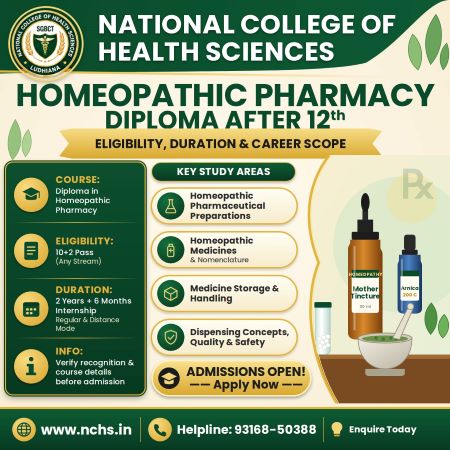
Diploma in Homeopathic Pharmacy: Eligibility, Duration & Course Details
Are you interested in homeopathic medicines, pharmacy-related education, and healthcare support services? The Diploma in Homeopathic Pharmacy is a course option for students who want to learn about homeopathic pharmaceutical preparations, medicine handling, storage, dispensing-related concepts, and pharmacy practices.
Homeopathic pharmacy focuses on the preparation, handling, storage, and supply of medicines used in homeopathy. Students pursuing this field can develop knowledge of pharmaceutical terminology, homeopathic formulations, quality and safety practices, and the responsibilities associated with handling medicines.
In this blog, we will explain the Diploma in Homeopathic Pharmacy, including eligibility criteria, course duration, study modes, syllabus, admission process, and potential career opportunities.
What Is a Diploma in Homeopathic Pharmacy?
The Diploma in Homeopathic Pharmacy is a pharmacy-related educational programme focused on the principles and practices associated with homeopathic medicines.
Depending on the curriculum, the course may introduce students to homeopathic pharmaceutical preparations, commonly used medicines, dispensing-related procedures, medicine storage, inventory management, and basic pharmaceutical concepts.
The programme may be of interest to students who want to explore pharmacy-related work in settings dealing with homeopathic medicines.
However, students should distinguish between completing an educational course and obtaining the legal qualifications or permissions required for regulated pharmacy activities. The course's awarding body, recognition status, and professional applicability should be verified before admission.
Diploma in Homeopathic Pharmacy: Course Overview
Here is a quick overview of the course details.
|
Course Detail |
Information |
|
Course Name |
Diploma in Homeopathic Pharmacy |
|
Eligibility |
10+2 (Any Stream) |
|
Course Duration |
2 Years + 6 Months Internship |
|
Study Mode |
Regular & Distance |
|
Course Focus |
Homeopathic pharmacy and medicine-related education |
|
Admission |
Subject to the institution's admission policy |
Note: The eligibility, duration, internship, and study modes listed above are based on the course information provided. Students should confirm the current syllabus, practical training arrangements, internship requirements, and applicable recognition details with the institution.
Eligibility Criteria for Diploma in Homeopathic Pharmacy
Students who have completed their Class 12 education may consider applying for the Diploma in Homeopathic Pharmacy, subject to the admission criteria of the institution offering the programme.
Educational Qualification
- Applicants should have passed Class 12 (10+2).
- Students from any stream may apply according to the stated course eligibility.
- Additional admission conditions, if applicable, should be confirmed with the institution.
Who Can Consider This Course?
This programme may be relevant to students who:
- Are interested in homeopathic medicines and pharmacy-related subjects.
- Want to learn about medicine storage and handling.
- Wish to explore pharmacy-related educational pathways.
- Want to understand pharmaceutical terminology and homeopathic preparations.
- Are considering further study in a related field, subject to eligibility.
Before enrolling, students should verify whether the course meets their intended academic or professional objectives.
Duration of Diploma in Homeopathic Pharmacy
The stated duration of the Diploma in Homeopathic Pharmacy is 2 years, followed by a 6-month internship.
The internship component is intended to provide practical exposure where it forms part of the institution's prescribed programme. Students should confirm the nature of the internship, the organisation in which it will be completed, supervision arrangements, and assessment requirements.
The total stated course pathway is therefore 2 years of study plus 6 months of internship. The actual schedule and completion requirements should be confirmed with the institution.
Study Modes: Regular and Distance
The course information provided lists both regular and distance modes.
Regular Mode
Regular study may involve scheduled classes, academic sessions, assignments, examinations, and practical activities according to the institution's curriculum.
Students should check the attendance requirements and the availability of supervised practical training.
Distance Mode
Distance learning may offer greater flexibility for students who cannot attend regular classes. However, the availability of distance mode should not be treated as confirmation that all practical or internship requirements can be completed remotely.
Before admission, students should obtain written information about:
- The study materials and teaching arrangements.
- Any required in-person classes or practical sessions.
- Internship arrangements and attendance.
- Examination schedules and assessment methods.
- The qualification awarded on successful completion.
For pharmacy-related education, the suitability of the study mode for the intended professional activity is particularly important.
Diploma in Homeopathic Pharmacy Syllabus
The syllabus may vary according to the institution and the course's prescribed curriculum. The following subjects represent possible learning areas and should not be treated as a confirmed official syllabus.
1. Introduction to Homeopathic Pharmacy
Students may be introduced to the meaning, scope, terminology, and foundational concepts of homeopathic pharmacy.
2. Homeopathic Pharmaceutical Preparations
This area may cover introductory concepts relating to homeopathic preparations and the methods used to prepare different formulations.
3. Homeopathic Medicines
Students may study commonly discussed homeopathic medicines, their nomenclature, and their forms of preparation.
4. Medicine Storage and Handling
Proper storage and handling are important for maintaining product quality. Students may learn about storage conditions, labelling, stock organisation, and safe handling practices.
5. Dispensing-Related Concepts
The curriculum may introduce the terminology and procedures associated with medicine dispensing, documentation, and prescription-related workflows.
Actual dispensing activities must be carried out only where permitted and under the applicable requirements.
6. Pharmaceutical Safety and Quality
Students may learn about hygiene, product quality, packaging, documentation, and the importance of following relevant legal and safety requirements.
7. Practical Training and Internship
Where included in the programme, practical training may provide exposure to pharmacy-related workflows. Students should confirm the internship's duration, approved setting, supervision, and assessment requirements before taking admission.
Skills Developed During the Course
A pharmacy-related educational programme may help students develop knowledge and skills in the following areas:
- Medicine handling: Understanding the importance of appropriate handling and storage.
- Documentation: Maintaining accurate records and organised inventory information.
- Pharmaceutical terminology: Becoming familiar with common pharmacy-related terms.
- Attention to detail: Recognising the importance of correct labelling and record keeping.
- Quality awareness: Understanding basic quality and safety practices.
- Professional responsibility: Recognising the limits of one's training and the importance of following applicable regulations.
These skills may be useful in suitable support roles, depending on the qualification and the employer's requirements.
Career Opportunities After Diploma in Homeopathic Pharmacy
Career opportunities depend on the course's recognition status, the student's practical training, employer requirements, and applicable regulations.
Students may investigate the following areas where their qualifications are accepted.
1. Homeopathic Pharmacy-Related Roles
Graduates may explore suitable pharmacy support or medicine-handling roles in organisations that accept their qualification and where the duties are legally permitted.
2. Inventory and Stock Management
Pharmacy-related organisations may require staff to assist with stock records, storage organisation, inventory documentation, and other administrative activities.
3. Pharmacy Administration Support
Depending on the employer's requirements, learners may explore administrative support roles involving records, documentation, product information, or routine coordination.
4. Further Education
Students may consider further study in pharmacy or related fields if they meet the relevant admission criteria.
5. Medicine Supply and Distribution Support
Some organisations involved in the distribution of homeopathic products may have support roles related to stock coordination, documentation, and product handling. Eligibility depends on the nature of the work and applicable requirements.
Important: Completing a Diploma in Homeopathic Pharmacy does not automatically guarantee employment, pharmacist registration, or authorisation to independently dispense medicines. Students should verify the professional applicability of their specific qualification before accepting a regulated role.
Is a Diploma in Homeopathic Pharmacy Recognised?
Recognition is an important consideration when selecting any pharmacy-related course.
The name of a course alone does not establish that it is recognised for every professional purpose. Students should confirm the awarding body's authority, the qualification's status, and the requirements of the relevant licensing authority.
India's Drugs Rules, 1945 include provisions concerning the qualifications of a competent person for specified homeopathic medicine sale licences. These provisions refer to a Diploma in Homeopathic Pharmacy among the listed qualifications, subject to the applicable rules and licensing conditions. This should not be interpreted as a blanket guarantee that every course with a similar name qualifies its holder for every pharmacy role or licence.
Before admission, students should:
- Verify the institution and awarding body.
- Request the official course syllabus and internship details.
- Confirm whether the qualification is accepted for the intended role.
- Check the applicable licensing conditions with the relevant State Licensing Authority.
- Obtain written clarification regarding any claims about recognition, registration, or employment eligibility.
This verification is particularly important for students who intend to work in medicine supply, dispensing, or other regulated activities.
Admission Process for Diploma in Homeopathic Pharmacy
The admission process may differ by institution. Students can generally follow these steps:
- Check eligibility: Confirm that you meet the Class 12 admission requirement.
- Select the study mode: Review the regular and distance options currently offered.
- Review the syllabus: Obtain details of subjects, practical training, examinations, and internship requirements.
- Verify the qualification: Check the awarding body and the course's recognition status for your intended career.
- Confirm fees and duration: Request written information about tuition fees, examination fees, internship arrangements, and any additional charges.
- Submit the application: Complete the institution's application process and provide the required documents.
- Retain admission records: Keep copies of the application, admission confirmation, fee receipts, and other relevant documents.
Students should carefully review all course terms before making a payment.
Frequently Asked Questions (FAQs)
1. What is a Diploma in Homeopathic Pharmacy?
It is a pharmacy-related educational programme that may cover homeopathic pharmaceutical preparations, medicine handling, storage, dispensing-related concepts, and pharmacy practices.
2. What is the eligibility for Diploma in Homeopathic Pharmacy?
The stated eligibility for the course described in this blog is Class 12 (10+2) in any stream, subject to the institution's admission requirements.
3. What is the duration of Diploma in Homeopathic Pharmacy?
The stated duration is 2 years of study plus a 6-month internship. Students should confirm the schedule and completion requirements with the institution.
4. Is Diploma in Homeopathic Pharmacy available in distance mode?
The course information provided lists regular and distance modes. Students should confirm current availability and whether practical training or internship requires in-person attendance.
5. What subjects are covered in Diploma in Homeopathic Pharmacy?
Depending on the curriculum, the course may cover homeopathic pharmaceutical preparations, medicine handling, storage, pharmaceutical terminology, dispensing-related concepts, documentation, and quality and safety practices.
6. What are the career opportunities after this diploma?
Depending on the qualification and applicable requirements, graduates may investigate suitable pharmacy support, inventory, administrative, or medicine-distribution support roles, as well as further education.
7. Does this diploma automatically qualify me to work as a registered pharmacist?
No. Students must verify the qualification's recognition and the applicable registration or licensing requirements. Completion of a course alone does not guarantee eligibility for every regulated pharmacy role.
8. Is an internship included in the course?
The course details provided for this blog list a 6-month internship after 2 years of study. Students should confirm the internship arrangements, supervision, assessment, and completion requirements directly with the institution.
Conclusion
The Diploma in Homeopathic Pharmacy may be an educational option for students interested in homeopathic pharmaceutical preparations, medicine handling, and pharmacy-related support work.
The course details covered in this blog are:
- Eligibility: 10+2 (Any Stream).
- Duration: 2 years plus 6 months of internship.
- Study Mode: Regular and Distance.
Before enrolling, students should carefully review the curriculum, practical training, internship arrangements, awarding body, and professional applicability of the qualification.
An informed decision can help students choose a programme that aligns with their educational goals while understanding the legal and professional requirements associated with pharmacy-related work.